
This walk starting from Barnes Bridge Station can also be easily accessed from either Chiswick Station or Hammersmith (Tube) Station. The walk is mainly level and, if starting from Barnes Bridge, measures 5.65 miles (9.09 kilometres).
It takes in both banks of the Thames but leaves the river to explore the classical gardens of Chiswick House. It returns to the river via Chiswick churchyard, where Hogarth’s grave can be seen, then passes the fine buildings of Chiswick and Hammersmith Malls to cross Hammersmith Bridge. The return route has a more rural feel and takes in the Leg o' Mutton Nature Reserve.
If starting from Chiswick Station, leave from Platform 1 and turn right past the shops, following Burlington Lane, past the first entrance to Chiswick House, bearing left as it becomes a main road. Turn through the main gates in another 50 metres, then follow the instructions from point 3 onwards.
If starting from Hammersmith (District/Piccadilly Line) Tube, on leaving the station, note the direction sign to Talgarth Road, and follow the indicated route through and out of the shopping centre. Use the pedestrian-controlled lights to cross the road under the flyover. Turn right past the Apollo Theatre, then turn left down Queen Caroline Street. On reaching Hammersmith Bridge, cross the river and turn right, then follow the instructions from point 9.
1. From Platform 1 of Barnes Bridge Station (National Rail from Waterloo), find the footbridge across the river by the railway, pausing on the way to admire the fine view of the Barnes riverfront. At the far end of the bridge, descend steps and keep alongside the river, crossing in front of a boathouse, then along terraces forming part of Duke’s Meadows, passing a bandstand and shelters en route.
There is a temporary diversion (April 2022) at the end of Barnes Bridge. To regain the route, go forward, bearing right where possible to arrive at Duke's Meadows.
2. Duke’s Meadows, an area of some 80 hectares, were originally owned by the Duke of Devonshire, and passed to the-then Chiswick Council in the 1920s when a riverside promenade was laid out. The meadows now consist mainly of sports fields. Where the terraces come to an end, look for a sculpture of storks on a nest, then turn left by a hut. Follow the drive ahead to the end, go through gates and turn left along Edensor Road, using the crossing to reach the lights in about 70 metres, where cross and turn right along Alexandra Avenue. Cross Burlington Lane and, in another 50 metres, go through the main gate of Chiswick House, with the house in front of you framed by magnificent Cedar of Lebanon trees. An information board here has a good map of the grounds.
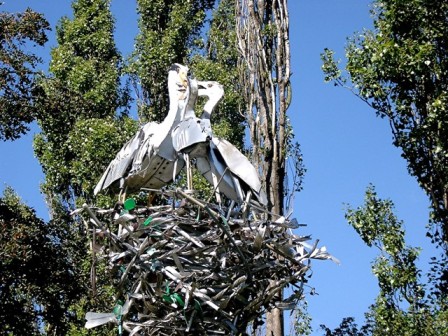 Storks Sculpture |
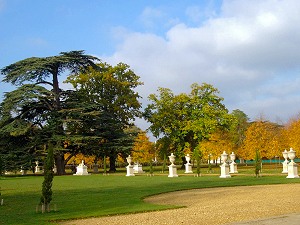 Chiswick House Gardens |
Chiswick House is considered one of the finest examples of Palladian architecture in Britain and was designed by the 3rd Earl of Burlington. It was built between 1725-29, being meant as a showcase for Burlington’s art collection rather than as a residence. The gardens of over 26 hectares were designed by William Kent and are considered to be the forerunner of the English Landscape Movement. A £12 million restoration scheme was completed in 2010. Chiswick House is an English Heritage property and open to the public (admission charge). The gardens, however, are free to visit.
3. Turn left on the crossing path just before the house forecourt and cross over a bridge. Ascend the steps on the left, continuing on the elevated path until more steps descend to an obelisk. If you would prefer to remain on the level, just continue on the original path, which also arrives at the obelisk. Facing the figures in low relief on the obelisk — this panel is a replica of a Roman tombstone, the original of which is now in the house — take the forward path through the woods to arrive opposite the Ionic Temple. Turn right alongside the lake and then left at its end past the Cascade. Re-cross the bridge, shortly turning left through a gate, and make for the lawn with its collection of urns behind the house. Continue past more Lebanese cedars down to the end of the lawn (the Exedra) to view the replicas of statues of Roman emperors — said to have come from Hadrian’s Villa at Tivoli. The originals have been moved into the house for conservation reasons. Ease right to the patte d’oie (goose-foot), a multi-pathed junction of yew hedges and take the leftmost avenue down to the Classical Bridge, passing the Ionic Temple and Amphitheatre on the left.
4. Don’t cross the bridge, but ease right with railings on the left. After 15 metres, find a twisting path on the right, signposted to the car-park. Follow this through woodland, never far from the park’s boundary wall, until the exit to the car-park is reached. Turn sharp right now, by the Rustic House, which contains a bust of Napoleon, to follow a path between yew hedges, turning left through a gap after about 80 metres. The path arrives at the Rosary in the middle of which is the Doric Column, topped by a fetching statue of the Venus de Medici — a copy of that in the Uffizi Gallery in Florence. Now go forward to the Deer House, a small white building, and turn left on the path just before it. Turn right on a curving path by a gate to arrive at the Conservatory, a long white glasshouse, which contains the oldest camellia collection in England, and best visited in February to March. Pass between the Conservatory (which is open to the public) and the sunken Italian Garden. On reaching the end of the conservatory, go down steps and through an offset gap in the wall to find a path ahead, where turn right. However, if you wish to visit Hogarth’s House, also open to the public, turn left at this junction and, on reaching the main road (Hogarth Lane), turn right and follow it for 300 metres, before later returning to this point.
5. Continue with the park wall on the left to leave the park at South Lodge Gate. However, should you need refreshments, the signed path opposite the lodge will take you to the park café and toilets. Turn left along Burlington Lane. A short way along, cross the road by the light-controlled crossing. Continue for another 70 metres, then turn right along Powell’s Walk between high walls, the wall on your right hiding Chiswick Old Cemetery. You arrive at Chiswick Parish Church, which was rebuilt by J L Pearson in 1882, but contains old monuments. The tower is medieval, built c1436. Pass through the churchyard, noting Hogarth’s grave, a large railed monument, surmounted by an urn. Go down steps and continue forward along Chiswick Mall. Note the drawdock at the start of this stretch, the site of an ancient ferry. Chiswick Mall is a spectacular showpiece of mainly 18th century houses, some hiding even earlier parts. An unusual feature here is that the road divides the front gardens from their houses. Walpole House, the finest of them all, has features dating back to the 16th century and was the home of a nephew of Britain’s first prime minister.
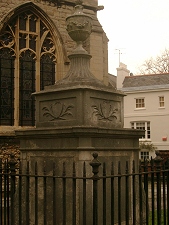 Hogarth’s Grave |
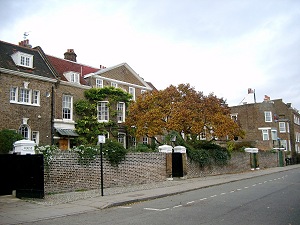 Chiswick Mall |
6. Towards the end of Chiswick Mall, just after a rise and fall in the road, turn left into Eyot Gardens, then right into Mulberry Place, to view a row of rustic cottages with pretty front gardens on the left, then emerge at the corner of the much grander Hammersmith Terrace (built c1750), where turn left, noticing the blue plaques to former famous residents. At the corner of Black Lion Lane, turn right to the river again.
The vicinity of the Black Lion pub was reputedly haunted by the Hammersmith Ghost, an apparition that physically attacked its unfortunate victims. The Times reported one pregnant woman literally scared to death. Local patrols were mounted to tackle the ghost but to no avail. Late in the evening of 3 January 1804, a local excise man, one Francis Smith, took it upon himself to lay the ghost. He “filled his blunderbuss with shot and himself with ale” and set forth. It was the misfortune of a white-clothed workman, Thomas Millwood, to be passing by and Smith shot him dead. Locals, having heard the shot, apprehended Smith. The body was taken to the pub and the subsequent inquest returned a verdict of “a rash act of wilful murder”.
At his trial, Smith gave a statement in which he said that he had committed the act “in confusion and dread”. The trial jury at the Old Bailey declared a verdict of manslaughter, which the judge refused to accept, redirecting the jury to return a verdict of murder. A death sentence was subsequently passed, although this was later commuted to a year’s hard labour. It was not until 1988 that a legal judgement was given that an honest but unreasonable belief could be used in defence.
A few days after the fatal shooting, a local shoemaker named John Graham was arrested on a charge of nuisance for dressing in a blanket and impersonating the ghost. He admitted having done so to frighten his apprentices. Whatever the truth of the story, the Hammersmith Ghost henceforth ceased to haunt the area.
7. Continue forward along Upper Mall by the river. The building with arches at the start are the remains of Hammersmith Pumping Station. The buildings along Upper Mall are mainly Victorian villas with some older ones dispersed among them. At the end of Upper Mall stands Kelmscott House, home of William Morris between 1878-96 and now the headquarters of the William Morris Society. The basement and coach house contain a small museum. The coach house marks the site of the first electric telegraph. Go forward into the alleyway linking into Furnivall Gardens and pass The Dove.
Recommended pub: The Dove, on Upper Mall, a charming 18th century riverside pub has two claims to fame: it was where James Thomson wrote the words to “Rule Britannia” and the front bar is claimed to be the smallest in Britain, measuring just 1.27m by 2.39m. The main bar fortunately is larger but can still get very crowded.
8. Emerging from the alleyway, go forward to take the curving path across Furnivall Gardens. The gardens were the site of the now-vanished Hammersmith Creek and were created in 1948. Prior to that date, the area was the site of old wharves. The walled garden on the left was a former Quaker burial ground. At the end of the path, rejoin the riverside. There are a number of houseboats moored hereabouts. On reaching Hammersmith Bridge, go under it, then turn left and left again to cross the river. (Walkers from Hammersmith Station join here). This ornate bridge, dating from 1887, is the second one on the site and was designed by Sir Joseph Bazalgette. It is the only bridge of its design in Britain, and the only other one of its type spans the River Danube in Budapest.
9. At the end of the bridge, reverse direction and pass under it, to walk with the river now on your right. This is a pleasant tree-lined stretch with views across the river to your earlier route. We now follow this next section for just over a kilometre. The path gradually swings left, with a mixture of open spaces and low buildings. Across the river can be seen the pubs and houses of Hammersmith Mall, with the octagonal tower of St Peter, the oldest of Hammersmith’s churches, built 1827-9, in the distance. Further on, the buildings on our left begin to give way to open ground and, across the river, the views are now of the tall houses of Hammersmith Terrace, followed by Chiswick Mall, terminated ahead by St Nicholas’ Church, with its funny little spike on top of the tower.
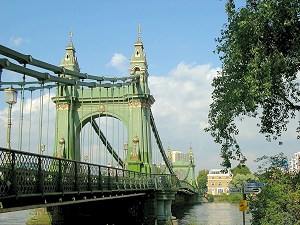 Hammersmith Bridge |
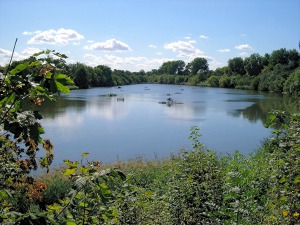 Leg o’ Mutton Reservoir |
10. Eventually our path straightens up. Opposite the island of Chiswick Eyot, across the river, take a broad left fork running away from the river. At an obvious cross-path, with the buildings of the Swedish School on the corner, turn left. Just before reaching the road, turn right through the swing-gate to enter the Leg o’ Mutton Nature Reserve. Turn right (i.e. back on yourself) and walk along the raised embankment with the reservoir on your left. The path soon bends to run parallel with the river again.
(NB: Should you miss the fork described above, just continue alongside the Thames until you reach a broad path turning off left by a litter bin. Take this and walk on until the entrance to the nature reserve is reached).
11. Leg o’ Mutton (or Lonsdale Road) Reservoir, in operation from 1838 to 1960, takes its name from its shape. Bats are known to roost in the old poplar trees here, and a number of bird species, including grebes, cormorants and the rare pochard, use the lake, which is not far from the London Wetlands Centre. A walk around the entire perimeter comes to about a mile, although your route only follows about half of this. Where the path takes a definite left turn, soon after the end of the water, go right through a gate, then left between the edge of Small Profit Dock Gardens and the Thames towpath. As towpath, road and gardens all meet, notice a cow on the balcony of the house standing at the corner of Gerard Road opposite! Now follow Lonsdale Road alongside the river and cross using the pedestrian crossing at the corner of Barnes High Street.
Recommended pub: If you fancy a drink, the Coach and Horses is a cosy former coaching inn which serves real ale and has a large garden. To get there, turn into Barnes High Street, by the mini-roundabout, to find the pub a short distance up on the right. There are cafés here also.
12. Continue along The Terrace to return to Barnes Bridge Station, which is on the left by the railway bridge. Many of the houses along here date from the 18th century and have elegant iron balconies. Gustav Holst, the composer, lived at No 10. Barnes Railway Bridge carries the Hounslow Loop Line and dates from 1849, but was rebuilt in 1895. Chiswick Station is one stop away. There is currently (Aprll 2022) no direct bus route to Hammersmith, pending the refurbishment of Hammersmith Bridge.
© Mike Biggs, Ramblers (Inner London Area), 2022.
If you have any comments about this walk, or notice that it needs updating to take account of changes on the route, then please contact Mike at